

A procedure describes how a task is meant to be performed. A completed record describes what happened on a particular occasion. They may begin as the same form, but they do different jobs. Keeping that distinction clear makes a training exercise, data-cleaning task or laboratory measurement easier to understand months later.
The most common mistake is to keep only the latest template and assume it explains every older result. If the template changed, it may no longer describe the fields, decisions or instructions used when the earlier work occurred. A useful record therefore needs a connection to the version that applied at the time.
Identify the instruction and the event separately
Imagine a fictional research group checking files received from an instrument. Its procedure tells a reviewer to confirm the sample identifier, file type and measurement units. Its completed record says which files were checked, who performed the review and which exceptions were found. The first can apply repeatedly; the second belongs to one review event.
The World Health Organization’s guidance on documents and records distinguishes instructions governing testing services from the records generated through their activities. It also emphasizes approval, revision control and retrieval. Those principles are useful beyond the specific testing context in which the guidance is presented.
A blank form can change roles when completed
A blank worksheet is a controlled template if it defines what information should be collected. Once filled in for a particular event, it becomes evidence of that event. The completed worksheet should retain enough information to identify both itself and its originating template.
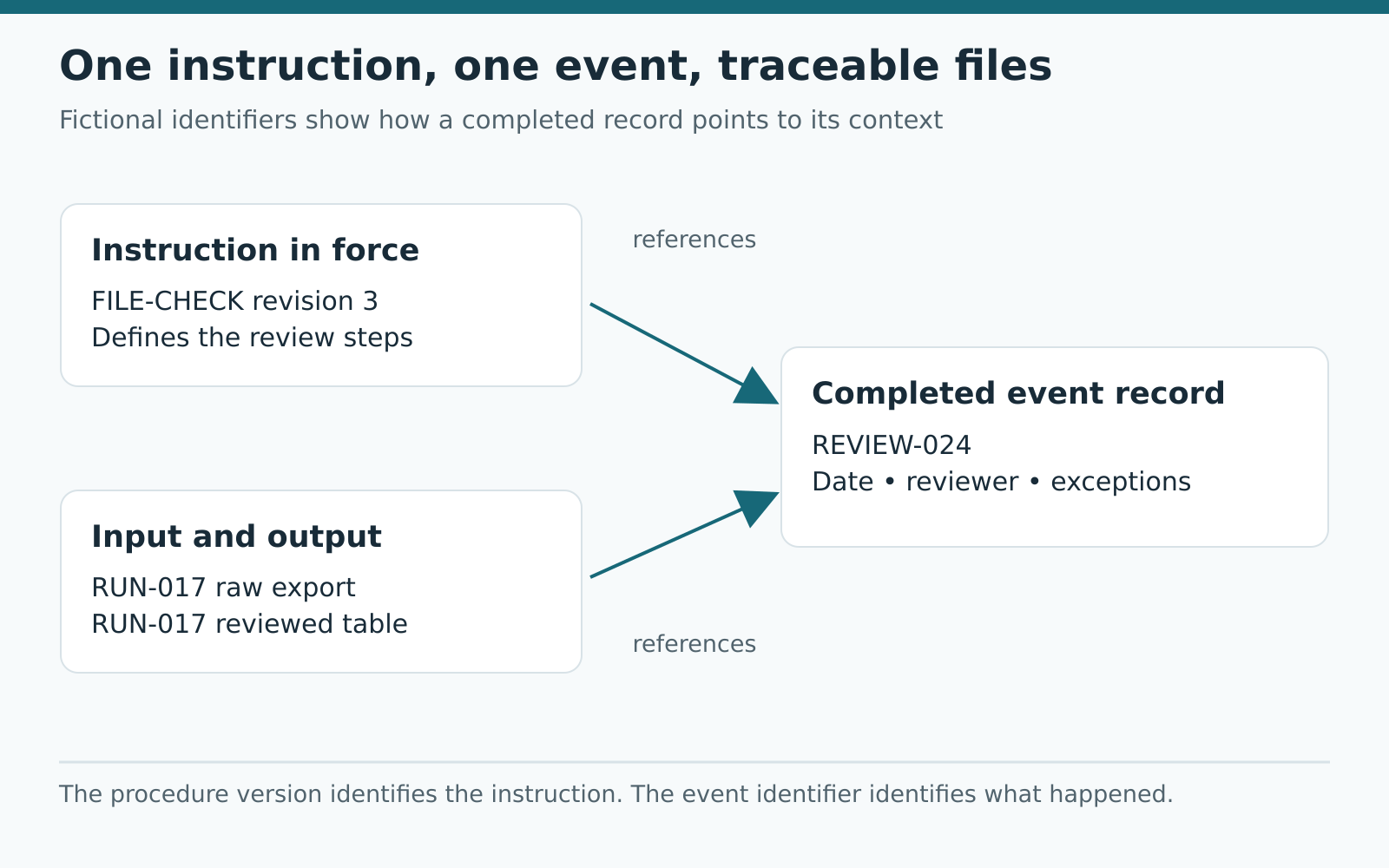
For example, a fictional form might carry template identifier FILE-CHECK, revision 3, and a separate record identifier REVIEW-024. Revision 3 explains the layout and instructions. REVIEW-024 identifies the actual review. A date alone is usually a weaker identifier because several events can occur on the same day.
This distinction also prevents a confusing shortcut: renaming every file final. A filename can be convenient for navigation, but it should not be the only place where the version or event is identified. Files can be moved, renamed and exported.
Keep a short chain of references
| Item | Fictional identifier | Question answered |
|---|---|---|
| Procedure | FILE-CHECK revision 3 | Which instruction applied? |
| Completed review | REVIEW-024 | Which event is this? |
| Input file | RUN-017 raw export | What was examined? |
| Output | RUN-017 reviewed table | What was produced? |
The identifiers are deliberately simple. Their value comes from consistent relationships, not from complicated numbering. A reviewer should be able to move from the output to the event record and then to the instruction and source material without guessing which similarly named file is intended.
Distinguish a corrected record from a revised procedure
Suppose a reviewer entered the wrong file identifier in REVIEW-024. Correcting that entry changes the record of one event. Suppose instead that the group decides future reviews must include an additional unit check. That changes the procedure or template for later events. Both are changes, but their scope differs.
A correction should preserve what changed, the reason and the responsible person according to the system in use. A procedure revision should have an effective version and a clear description of the changed instruction. Silently replacing old records with a new blank form would conceal the difference between a historical correction and a future process improvement.
For a small educational project, a change log may be enough to make the distinction visible. The specific storage and approval system depends on the task. More elaborate software does not automatically compensate for ambiguous relationships between documents.
Capture exceptions at the time they occur
A completed record should allow an honest account of an unexpected event. If an input file lacked a unit label, writing passed after an informal conversation loses useful context. A clearer note states which field was missing, how the issue was resolved and which evidence supports the resolution.
Use a fictional example: a table contains the value 12 but its header says only concentration. The reviewer should not infer the unit from a previous file with a similar name. The record can identify the unresolved field and point to the corrected source when it becomes available. That preserves the difference between an observation and an assumption.
An exception field is most useful when it accepts specific information. A checkbox labelled problem is less informative than a short description tied to the affected file or row.
Make the record useful without making it enormous
ISO’s guidance on documented information distinguishes information maintained to support processes from information retained as evidence. It also describes documentation in relation to the needs of an organization’s processes. A large volume of paperwork is not the goal.
For the fictional file review, a concise record can contain the event identifier, procedure version, input and output references, date, reviewer and exceptions. Extra fields should answer an identifiable question. A field repeatedly left blank because nobody understands its purpose is a candidate for review, rather than proof of thoroughness.
Status is another useful field. A draft instruction may contain a proposed improvement without being the instruction currently in force. Give draft, approved and superseded versions distinct statuses so a reader does not mistake the newest timestamp for authorization to use the content. The purpose is to preserve the decision about which instruction applied, rather than making that decision depend on how a folder happens to be sorted.
Apply the same logic to a peptide measurement
In a peptide-analysis workflow, the instruction might describe how an instrument output is assessed, while the event record names the sample, reference material and files used. A number detached from those references cannot reveal which preparation or analysis produced it. The record connects the result to its context.
This does not mean that good documentation makes a measurement scientifically valid by itself. The method and equipment still need appropriate performance. Documentation makes the work examinable: it helps another person identify what was done, what changed and which question remains unresolved.
Before archiving a completed task, try a simple reading exercise. Open only its record and ask whether the relevant instruction and source files can be found. If a colleague must reconstruct the missing connections from memory, add the references while the context is still available. A small, coherent chain is more useful than a folder full of unconnected final versions.
